Board Membership
The Violence Reduction Board (VRB) is jointly chaired by West Midlands Police and Birmingham City Council. The partnership is committed to working with communities to bring about a culture change which demonstrates that violence is not inevitable, it is preventable. Preventing and reducing serious violence is one of the key priorities for the VRB.
The VRB brings together a wide range of partners, including:
- West Midlands Police
- Probation
- Birmingham City Council
- Office of Police and Crime Commissioner
- NHS Birmingham and Solihull ICB
- Youth Offending Service
- Birmingham Children’s Trust
- Department of Work and Pensions
- Community Safety Partnership
- West Midlands Violence Reduction Partnership
- Birmingham Social Housing Partnership
- Birmingham City Council Youth Services
- Birmingham Adult Social Care
- Third Sector
- Key commissioned services – Redthread
- Faith Organisations
This multi-agency collaboration ensures a comprehensive and coordinated approach to tackling violence in the city. The Birmingham Violence Reduction Board has oversight of the partnership response to the Serious Violence Duty.
Serious Violence Duty
As part of their wider response to crime, in January 2023 the Government introduced the Serious Violence Duty. The Duty requires specified authorities to “work together to share information and target interventions, to collaborate and plan to prevent and reduce serious violence”.
The specified authorities in Birmingham are Birmingham City Council, West Midlands Police, Youth Offending Teams, Integrated Care Board, Probation, and West Midlands Fire Service.
Preventing serious violence before it occurs and putting in place arrangements to reduce the violence if it does occur, continue to be a top priority for the Community Safety Partnership.
Requirements of the Duty
The Duty requires specified authorities to work together to:
- Adopt a public health approach
- Prevent and reduce serious violence
- Understand the causes and consequences of serious violence
- Create strategic needs assessments and strategies
- Consult educational, prison and youth custody authorities to prepare strategy
Objectives and the intended effects
To improve the current multi-agency approach involving partners and agencies such as education, health, justice, social services, housing, youth, and victim services to work collaboratively to tackle serious violence.
- To encourage organisations to share information, data, and intelligence to generate evidence-based analysis of the problem and solutions.
- To increase the effectiveness of partnerships to work together to identify the causes of serious violence and make plans to prevent/tackling serious violence.
- Alongside continued law enforcement, this duty supports partnership to understand and address the factors that cause someone to commit violent crime in the first place. This is not just a policing issue – to be successful in dealing with this threat, the partnership will focus on, preventing and reducing serious violence targeting activity to the people and places most at risk.
The intended effect is two-fold:
to increase effective collaboration across agencies and ultimately to reduce the number of serious violence offences
For more information on the Serious Violence Partnership Delivery Plan, follow the link below:
BCC_247_BirminghamSeriousViolence_v4 accessible.pdf
Violence Strategic Needs Assessment
The Birmingham Violence Reduction Board has led the city’s response to the Serious Violence Duty, including the development of a local Strategic Needs Assessment (SNA). This assessment provides a detailed understanding of the local challenges and drivers of serious violence and informs the city’s strategic response.
The Strategic Needs Assessment is available on the Birmingham City Council Observatory – Supporting delivery of the Serious Violence Duty in Birmingham — Birmingham City Observatory.
West Midlands Violence Reduction Strategy
The West Midlands Violence Reduction Strategy is the regional response to serious violence. It sets out how partners will work together across the West Midlands and in our local places, to prevent and reduce the likelihood of children and young people under the age of 25, becoming a victim or perpetrator of violence. The strategy’s objectives include:
- Influence systems to deliver prevention across the life course
- Development of a sustainable, community led, and youth led approach to violence reduction
- Building regional and local partnerships that enhance collaboration and innovation
- Development of a West Midlands wide movement that aims for a violence free region
- Influence delivery of evidence-based programmes in educational settings
Birmingham Delivery Plan
The Birmingham Violence Reduction Board is committed delivering a realistic and achievable plan to ensure more effective and efficient use of the resources each agency has to serious violence collaboratively.
Birmingham Priorities
The Partnership has identified four key priorities. These priorities are based on the Birmingham Violence Problem Profile, Birmingham Violence Strategic Needs Assessment, what communities and children have told us, and what the wider partnership plans have set out:
- Priority 1 Partnerships (development and collaboration)
- Priority 2 Early intervention and protection from social harms across the life course
- Priority 3 Strengthening prevention with a placed-based approach in communities, schools, and settings
- Priority 4 Disruption
With delivery supported through three enablers:
- Strategic commissioning of support, intervention, and recovery
- Insight development, life course and population approach to data and lived experience
- Multi-agency practice, learning and development based in a trauma-informed approach
Our approach is underpinned by the adoption of the World Health Organisation’s definition of a public health approach to reducing violence: ‘Seeks to improve the health and safety of all individuals by addressing underlying risk factors that increase the likelihood that an individual will become a victim or a perpetrator of violence. By definition, public health aims to provide the maximum benefit for the largest number of people’
Useful Contacts:
| Birmingham Community Safety | Community safety | Birmingham City Council |
| Birmingham Children’s Trust | Birmingham Children’s Trust |
| Birmingham Youth Justice Service
|
Birmingham Youth Justice Service |
| Birmingham City Observatory | https://www.cityobservatory.birmingham.gov.uk/ |
| Crimestoppers | An independent charity helping to locate criminals and help solve crimes. Contact anonymously 24/7, on 0800 555 111. Visit https://crimestoppers-uk.org |
| Fearless
|
Fearless is a site where you can access non-judgemental information and advice about crime and criminality. What makes this site different is it also provides a safe place to give information about crime – 100% anonymously. Visit https://www.fearless.org/en |
| Integrated Care Board | Integrated Care Board |
| Probation Service | Probation Service |
| West Midlands Police | Call 999 in an emergency. For all other matters please visit West Midlands Police Online https://www.west-midlands.police.uk/ |
| West Midlands Violence Reduction Partnership | West Midlands Violence Reduction Partnership |
Useful information:
Useful contacts – reporting concerns:
| Childline | Childline is private and confidential service where you can talk to specially trained counsellors about anything that is worrying you. You can call on 0800 1111 |
| Crimestoppers | An independent charity helping to locate criminals and help solve crimes. Contact anonymously 24/7, on 0800 555 111. Visit https://crimestoppers-uk.org |
| Fearless
|
Fearless is a site where you can access non-judgemental information and advice about crime and criminality. What makes this site different is it also provides a safe place to give information about crime – 100% anonymously. Visit https://www.fearless.org/en |
| British Transport Police | If you notice something linked to the railways, you can report concerns by texting 61016 from your mobile |
| West Midlands Police | Call 101, or in an emergency 999 in an emergency. For all other matters please visit West Midlands Police Online https://www.west-midlands.police.uk/ |
Public Health Approach
The public health approach is a comprehensive way to help people, organisations, and systems understand how to prevent violence.
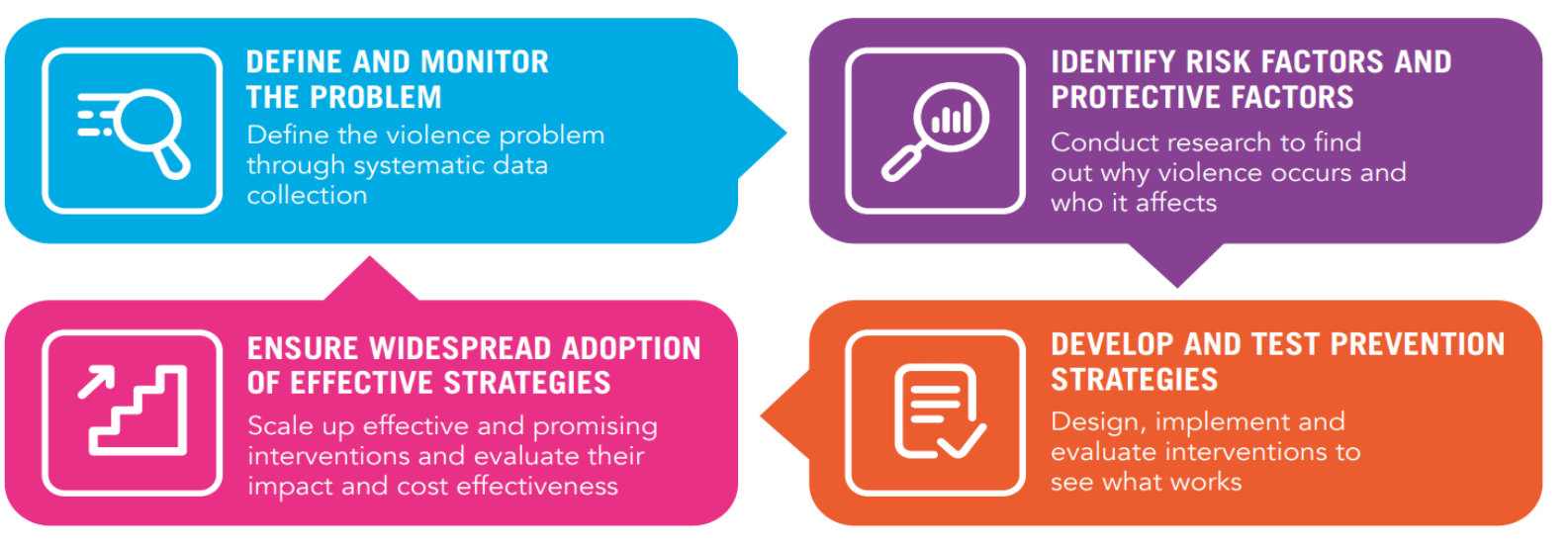
DEFINE THE PROBLEM collect data to find out the “who,” “what,” “where,” “when,” and “how” of violence happening
IDENTIFY RISK AND PROTECTIVE FACTORS – Risk factors are the characteristics or settings that increase the risk for violence. Protective factors buffer against the risk factors and decrease the likelihood of violence
DEVELOP AND TEST PREVENTION STRATEGIES using the information gathered in steps 1 and 2. Once prevention strategies developed rigorously evaluated to see if they prevent violence
WIDESPREAD ADOPTION effective strategies disseminated and implemented widely for greater impact
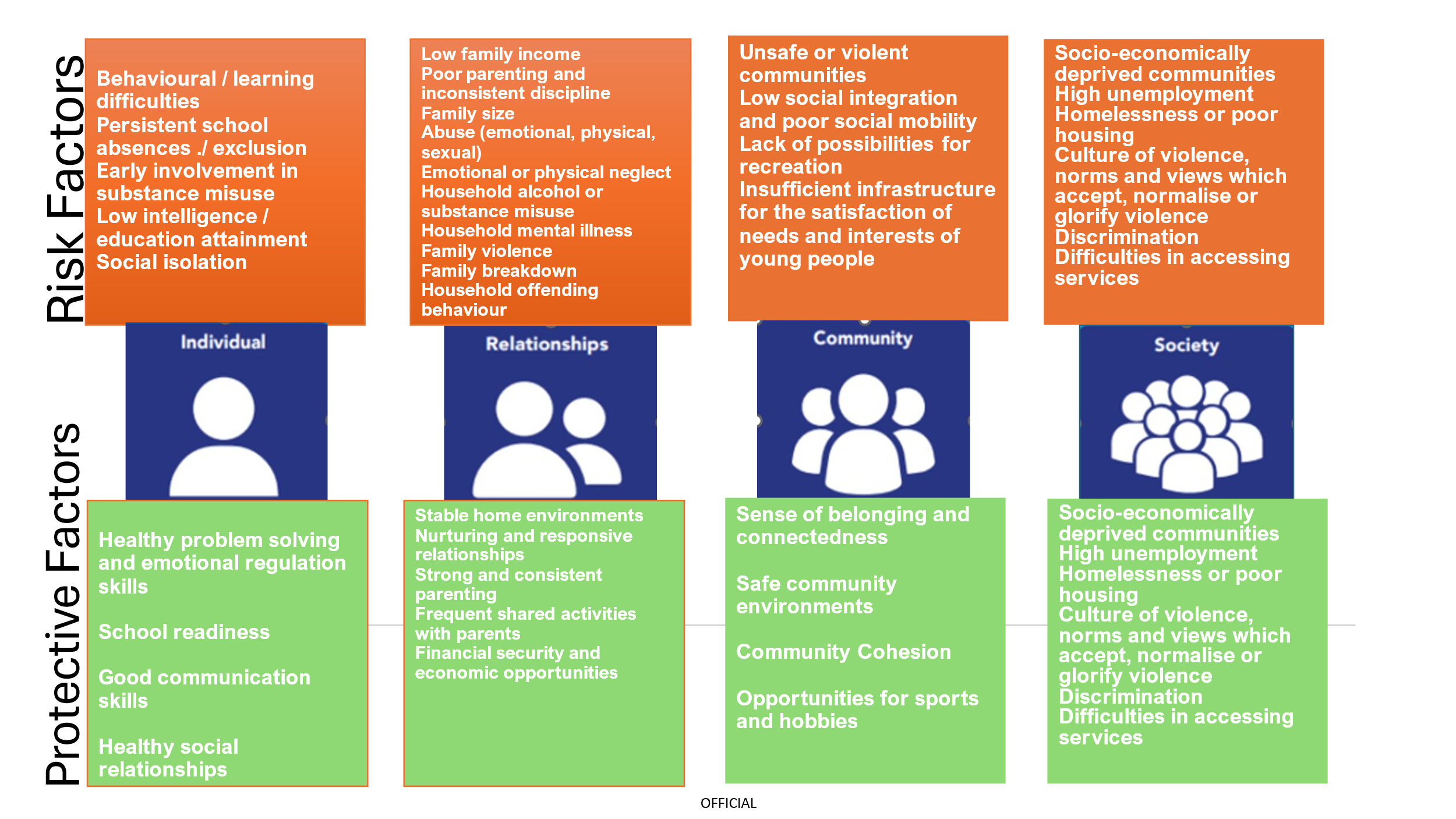
Risk Factors
There are multiple and complex issues that can increase the likelihood of violence happening ‘risk factors.’ These risk factors can arise from a complex interplay between a wide range of causes operating within and across individual, relationship, community, and societal domains