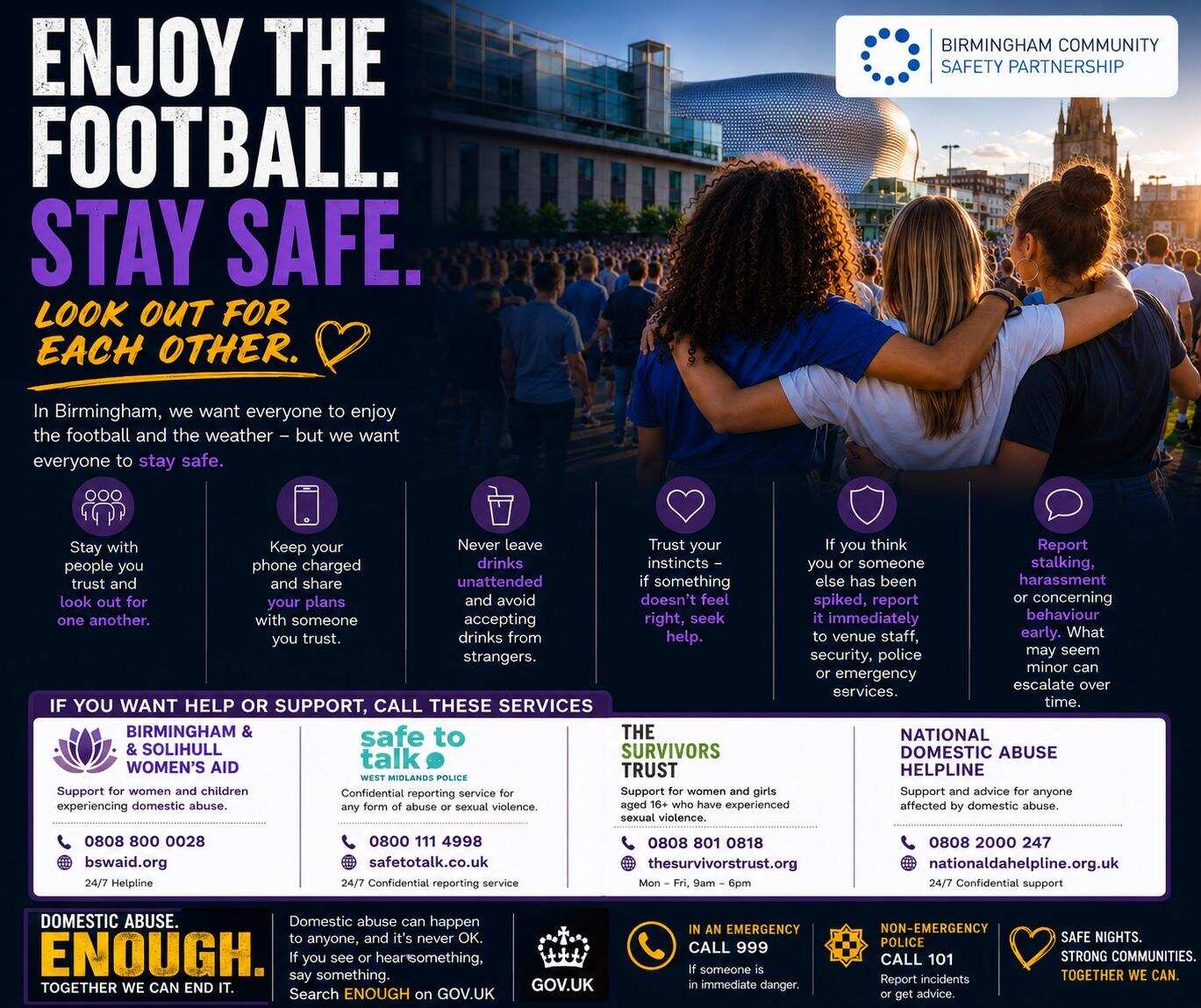
As football fever continues and people come together to enjoy matches, social events and the summer weather, we want everyone across Birmingham to have a safe and positive experience.
While major sporting events create fantastic opportunities for communities to celebrate together, they can also coincide with increases in incidents of violence against women and girls, including stalking, harassment and spiking.
Violence Against Women and Girls (VAWG) is an umbrella term that includes a range of behaviours such as harassment, stalking, sexual violence and domestic abuse. While abuse can affect anyone, women and girls are disproportionately impacted.
It’s important to be clear that football itself does not cause abuse. However, factors such as heightened emotions, increased alcohol consumption, and large gatherings may contribute to an increased risk in some situations.
Research has shown that during major football tournaments:
- Recent data shows that around 1.4 million adults experienced stalking in England and Wales in the year ending March 2025, with women more than twice as likely to be affected as men. Police also recorded over 141,000 stalking offences in the same period.
- Spiking remains a significant concern, with police receiving over 6,700 reports of spiking incidents in a recent year, and women accounting for around three-quarters of reported
- Domestic abuse incidents can increase by up to 38% when England loses
- Incidents may rise by around 26% when England wins or draws
- Abuse can remain elevated by approximately 11% the following day
- Some studies suggest alcohol-related domestic abuse may increase on match days (although alcohol does not cause abuse and is only one contributing factor)
- Police and support services often report increased demand and reporting during major tournaments
- As football fever continues and people come together to enjoy matches, social events and the summer weather, we want everyone across Birmingham to have a safe and positive experience.
Your safety is the priority. If you feel at risk:
- Try to move to a place of safety – This could be a public place, somewhere with other people around, or a location with staff or security present.
- Seek help if you need it- If you are in immediate danger, call 999. If not, consider contacting someone you trust.
- Trust your instincts- If something doesn’t feel right, it’s okay to leave or remove yourself from the situation.
- Talk to someone- You could speak to a friend, family member, neighbour, or colleague. You are not alone.
- Keep your phone accessible – Try to keep it charged and nearby so you can call for help or share your location if needed.
Access professional support
There are organisations and helplines that can provide confidential advice and support.
Calling 999 – Silent Solution (55)
If it isn’t safe to speak, you can still get help:
- Call 999
- Listen to the operator’s questions
- If you cannot speak, press 55 when prompted
- This lets the police know it is a genuine emergency and that you cannot talk safely
- Your call will then be transferred to police for assistance
If You Have Been Harmed
You can seek medical support through:
- Your GP
- A&E
- Specialist services
These services provide confidential and sensitive care. You can ask about your options before sharing information.
If You’re Worried About Someone Else
Whether you know the person or are acting as a bystander, you can help:
- Check in safely – A simple “Are you okay?” can make a difference.
- Stay nearby – If someone feels unsafe, being present or helping them leave can reduce risk.
- Listen without judgement – Let them speak at their own pace and reassure them it is not their fault.
- Encourage support – Signpost to professional services while respecting their choices.
- Act in an emergency – Call 999 if someone is in immediate danger.
Everyone deserves to feel safe. Let’s work together to ensure the World Cup is a positive experience for all , look out for yourself and others.